

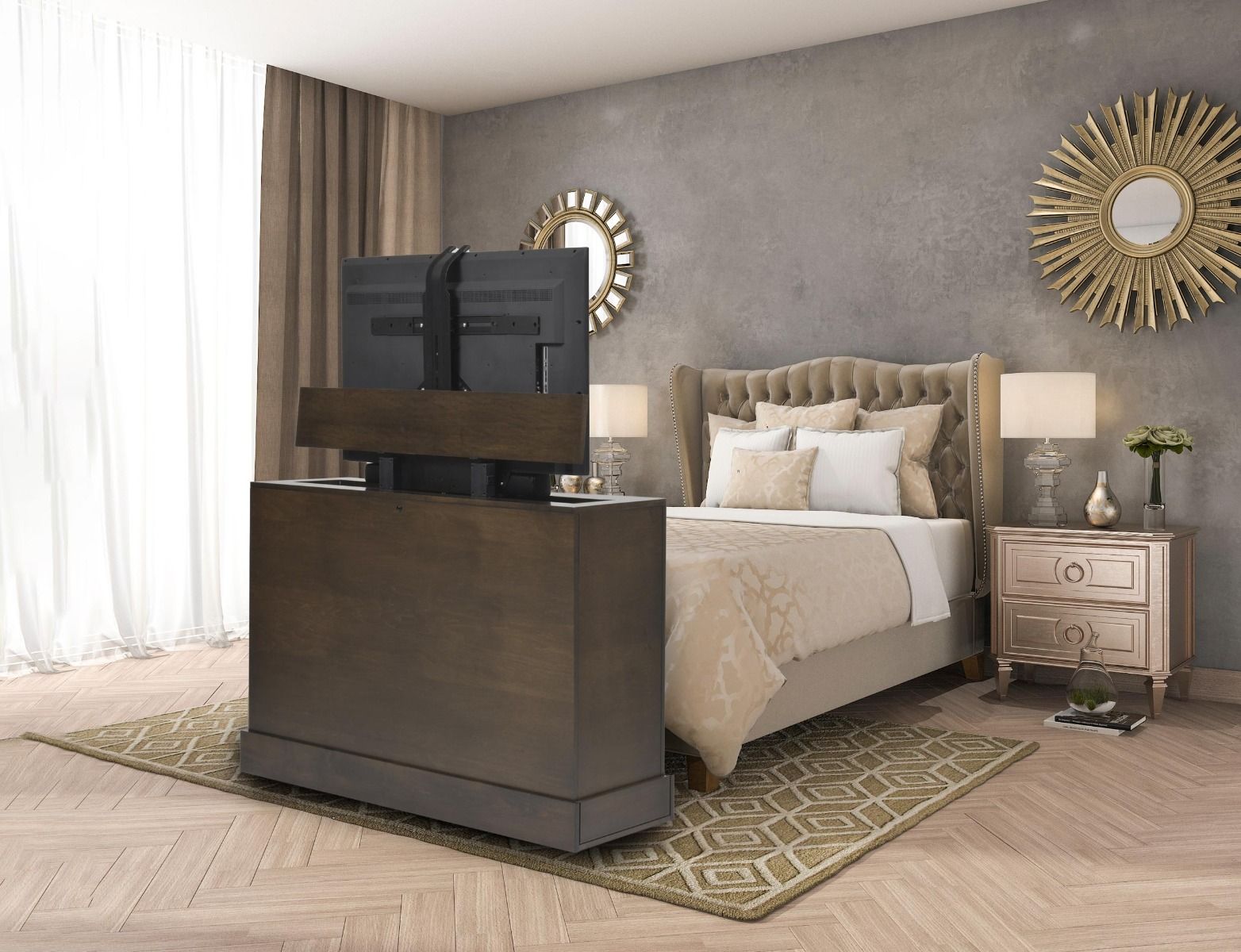
From living rooms to home offices, a full room-by-room guide to hidden TV cabinet ideas that keep the screen out of sight until you actually want it.
A hidden TV cabinet isn't just a living room concept the same idea, a TV that disappears when you're not using it, solves a design problem in nearly every room of the house. Here's how to apply it room by room.
Living room
This is the highest-stakes room for the "always-on black rectangle" problem, since it's usually the room guests see first and spend the most time in. A lift cabinet positioned centrally on the main wall, or beside a window where a wall mount wouldn't work well anyway, keeps the room reading as a considered living space rather than a room organized entirely around a screen. Pair the cabinet with real seating arrangement and lighting design, so the room looks complete and intentional with the TV down the TV should feel like a bonus, not the room's reason for being.
Bedroom
An end-of-bed lift cabinet (see our dedicated guide) is the most common bedroom application, keeping the room feeling like a genuine bedroom rather than a secondary media room the moment the TV lowers. This matters especially in primary suites, where many homeowners want the space to feel restful and calm rather than centered on a screen.
Home office
A lift cabinet positioned behind a desk, or along a side wall within view of a desk chair, lets you switch cleanly between "focused workspace" and "presentation or video-call mode" without a monitor or TV competing for visual attention during deep work. This is a particularly useful application for a home office that occasionally doubles as a media or presentation room for family use outside of work hours.
Kitchen or breakfast nook
A compact lift cabinet built into an island, peninsula, or nearby cabinetry keeps a small TV available for morning news, recipe videos, or background entertainment while cooking, without permanently occupying counter or wall sightlines the rest of the day. Kitchens are high-traffic, high-visibility spaces, so a screen that's only present when actually wanted tends to keep the room feeling clean and functional.
Guest room
In smaller homes where one room needs to serve double duty as both an occasional guest room and an everyday media or hobby room, a hidden TV cabinet lets the space default to "guest room" rather than "media room," with the TV available when needed but not defining the room's character the rest of the time.
Basement or secondary living space
Basements are often the room most likely to become purely functional — a place for a screen and not much else. A well-designed lift cabinet, especially paired with a fireplace insert (see our combined fireplace/TV lift guide), gives these secondary spaces the same sense of intentional design as a primary living room.
The common thread across every room
In each case, the underlying goal is the same: give yourself the option of a TV without giving the room over to a TV full-time. The room should look and feel complete and considered with the cabinet closed, and the TV should read as a feature you activate, not the organizing principle of the space.