

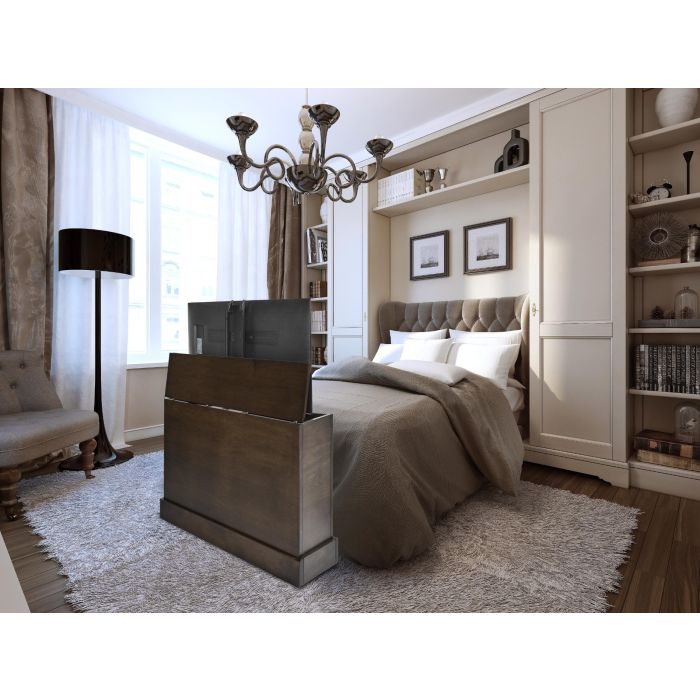
End-of-bed TV lift cabinets solve the small-bedroom TV problem without a wall mount or wasted floor space. A full buying guide for sizing, features, and layout.
In a small bedroom, the usual TV solutions don't work well. Wall-mounting isn't always possible renters can't drill into walls, plaster walls complicate mounting, and some rooms simply don't have a wall in the right sightline. A freestanding stand, meanwhile, eats floor space that's already scarce. An end-of-bed TV lift cabinet solves both problems at once: it functions as a real piece of bedroom furniture, provides storage, and only shows the TV when you actually want to watch something.
Why the end-of-bed format works so well in small rooms
The footprint at the end of a bed is often underused space in a small bedroom not quite big enough for a dresser, but too visible to leave empty. A lift cabinet turns that dead zone into functional furniture that does three jobs at once: seating-height storage, a design anchor for the room, and an on-demand TV.
Measuring your space correctly
Before shopping, measure the actual clear footprint at the end of your bed, accounting for walkway space you need to keep clear (aim for at least 24–30 inches of walking clearance beyond the cabinet's footprint in a small room). Also measure the distance from your mattress to the far wall this tells you the maximum cabinet depth that still leaves comfortable room to move.
Matching lift height to your bed
This is the detail most buyers overlook. The TV needs to rise to a height where it clears your natural sightline whether you're sitting up against pillows or lying flat. As a rough guide, measure your eye height when propped up in bed, and compare that to the cabinet's TV-up height in the product specs you want the center of the screen roughly level with or slightly below that eye height for comfortable viewing.
Cabinet depth and small-room proportions
Shallower cabinets (18–22 inches deep is common in end-of-bed designs) matter more here than in a living room, where floor space is rarely as tight. A deeper cabinet might offer more storage, but if it eats into your walking path or crowds the room visually, it works against the exact problem you're trying to solve.
Noise matters more here than anywhere else in the house
A living room TV lift operating with some ambient noise around it is rarely noticeable. A bedroom lift operating at 11pm, in an otherwise silent room, is a different story. Prioritize a quieter mechanism (see our linear actuator vs. scissor lift comparison) if the cabinet will regularly be used late at night or early morning.
Storage that actually earns the footprint
Since the cabinet already occupies prime bedroom real estate, look for models with real storage value drawers sized for folded linens or off-season clothing, or shelving that can double as a spot for books, a lamp, or decor when the TV's down. A cabinet that's purely a TV lift and nothing else is a harder sell in a room where every square foot needs to work.
Sizing the TV itself
For most bedrooms, a 40"–55" TV is proportionate to typical end-of-bed viewing distances (usually 6–10 feet). Going larger doesn't just look disproportionate in a small room it can also push the practical minimum cabinet width past what your space can actually accommodate.
Style considerations for a room that needs to still feel like a bedroom
Because this cabinet sits at the visual center of a small room, its finish and style carry more design weight than a similar piece would in a living room. A finish that matches your existing bedroom furniture (dresser, nightstands) keeps the room feeling cohesive rather than like a media console got dropped into a bedroom.