

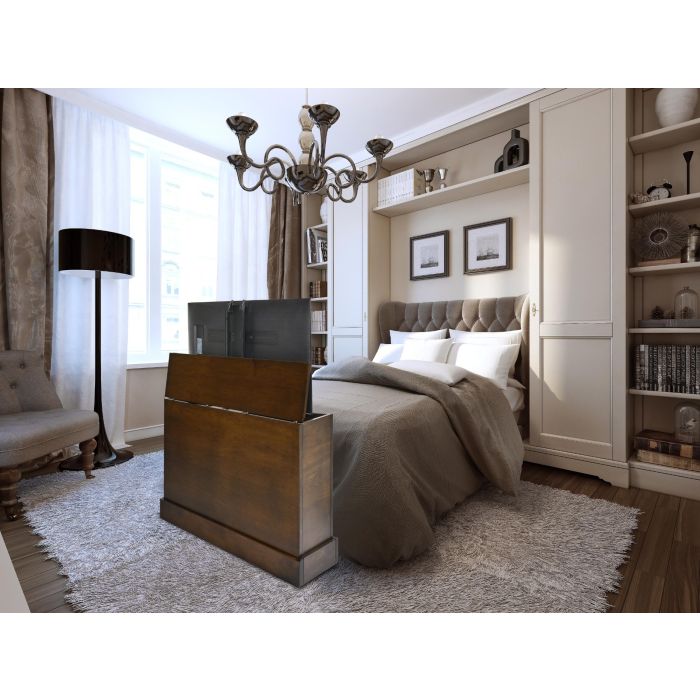
TV lift cabinets have been around long enough to pick up a few outdated assumptions, ones based on how the technology used to work rather than how it actually performs today.
One of the most persistent is the idea that these cabinets are too loud for everyday use. That was a fair criticism years ago, but modern lift mechanisms are engineered specifically for quiet operation. A well-built cabinet is barely noticeable during a lift cycle, quiet enough for bedroom use without disturbing anyone else in the room.
There's also a lingering belief that lift cabinets only belong in high-end custom homes. That hasn't been true for a while. The category has moved well past the custom home theater market, with off-the-shelf models now covering a wide range of budgets and room types, from apartment-scale consoles to full living room pieces. You don't need a custom build to get a hidden TV that works well.
Reliability concerns come up often too, the assumption that a motorized mechanism will inevitably break down. In most cases, that worry traces back to lower-quality lift systems rather than the technology itself. A cabinet built with a properly rated motor and tested for repeated lift cycles is designed for years of daily use, similar in reliability to any other motorized home hardware you'd trust without a second thought.
Style is another sticking point. Early cabinet designs leaned heavily traditional, lots of dark wood and formal detailing, which left a lot of people assuming that's the only look available. Current lineups include modern, minimalist, and mid-century-inspired finishes as well. The category has grown well beyond one aesthetic.
Installation worries stop a lot of people before they even start shopping. But most freestanding TV lift cabinets are built for standard furniture assembly, no wall drilling, no electrician, no specialty installer required. Built-in or fully custom installations may benefit from professional help, but a standard console or end-of-bed cabinet is typically a straightforward setup you can handle yourself.
Size capacity gets misunderstood too. Weight and dimensions vary by model, but plenty of cabinets are built specifically to support large-format TVs, sometimes handling more weight than a typical wall mount safely can. The key is matching a cabinet's rated capacity to your TV's actual weight rather than assuming bigger automatically means it won't fit.
And then there's the idea that the whole concept is a gimmick. It isn't. A hidden TV solves real, common problems: awkward room layouts, childproofing concerns, a screen that fights with the rest of a room's design. The function isn't novelty, it's a practical answer to a layout challenge most homes deal with in one form or another.
Most of the hesitation around TV lift cabinets traces back to how the technology looked ten or fifteen years ago, not how it performs now. Judged on current standards, that hesitation mostly doesn't hold up.
Explore our current cabinet lineup and see how far the technology has actually come.