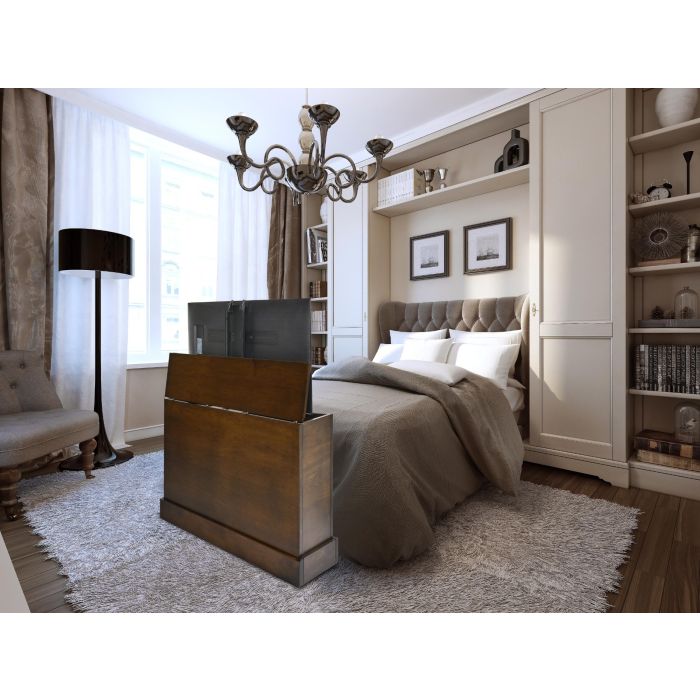

display
-
Common TV Lift Cabinet Myths, Debunked

TV lift cabinets have been around long enough to pick up a few outdated assumptions, ones based on how the technology used to work rather than how it actually performs today.
One of the most persistent is the idea that these cabinets are too loud for everyday use. That was a fair criticism years ago, but modern lift mechanisms are engineered specifically for quiet operation. A well-built cabinet is barely noticeable during a lift cycle, quiet enough for bedroom use without disturbing anyone else in the room.
There's also a lingering belief that lift cabinets only belong in high-end custom homes. That hasn't been true for a while. The category has moved well past the custom home theater market, with off-the-shelf models now covering a wide range of budgets and room types, from apartment-scale consoles to full living room pieces. You don't need a custom build to get a hidden TV that works well.
Reliability concerns come up often too, the assumption that a motorized mechanism will inevitably
Posted on: August 31, 2026Posted by: Jenn Mann -
Handcrafted, Not Mass-Produced
There's a difference between furniture that's assembled and furniture that's actually built. Walk through a big-box store and most of what you'll find is particleboard wrapped in a photo-printed veneer, held together with cam locks and a prayer. It looks fine in a showroom under bright lights. It does not look fine five years later.
Every TVLiftCabinet.com piece falls into a completely different category. These cabinets are handcrafted by skilled Amish artisans working out of Ohio, using real pine, oak, cherry, and mahogany solid hardwoods, joined the way furniture used to be joined before "flat-pack" became a standard word in the furniture industry. Nothing about the construction is an afterthought.
That distinction matters more than most people realize when they're shopping for a piece that costs several thousand dollars. A lift cabinet isn't decorative it's mechanical. It has to support a TV's weight, rise and lower smoothly, and keep doing that thousands of times over the course of
Posted on: August 11, 2026Posted by: Jenn Mann -
Sharp and Pioneer Bring Back the Line of Pioneer Elite Displays
Pioneer Elite HDTVs had been discontinued since 2009, but in a recent press release Sharp announced that it has been granted a license to begin producing Pioneer’s Elite brand of high-end displays in 2011. This is great news, especially since the Pioneer Elite screens were considered some of the top displays in their day, providing astounding color and black level reproduction. And the very impressive Pioneer Elite 60-inch flat-screen fit beautifully in the Banyan Creek XL TV Lift Cabinet.
After the country experienced a recession, however, these high-end (and high-dollar) displays could not withstand the onslaught of cheap LCD and plasma TVs. As part of the new deal, the flat-screen TV displays will be jointly marketed by Pioneer and Sharp, but they will only bear the name “Elite” and be sold, firstly, through Pioneer’s original Elite dealer network.
Sharp and Pioneer rightly believe that the market is once again ready for their Elite line of HDTVs, and we will be following the progress
Categories: Press , Banyan Creek TV Lift Cabinet , HDTVs , Pioneer , flat-screen , display , Sharp , ElitePosted on: February 08, 2011Posted by: Kerry Mann