
Page 25 - TV lift cabinet
-
Logitech Unleashes a ‘Couch Mouse’ for House Use

With today’s portability of electronics, people may be trading in their office chairs and desks for more comfortable surroundings more frequently. Perhaps in the traditional popularity of over-stuffed chairs and couches in coffeeshops, people who use their laptops at home are opting for the comforts of their own living room seating, at least enough are to warrant Logitech’s creation of the first Couch Mouse M515, which is completely optimized for soft surfaces, such as couches, beds or carpets. Now you can immediately go from watching your favorite movie on your flat-screen TV in front of your TV lift cabinet to pulling out your laptop and surfing the Internet without being bound to use the small, awkward finger pad present on most laptops. Logitech has made it possible to surf, shop and socialize with ease.
Now if you’re a real traditionalist and don’t like the idea of burning through batteries to have a wireless device, Logitech claims that the mouse will run for two years before needing
Posted on: February 25, 2011Posted by: Kerry Mann -
Product Focus: Seasons TV Lift Cabinet
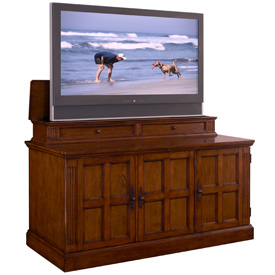
Beautifully built from pine and pine veneers, the Seasons TV Lift Cabinet is a pleasure to use year-round. Featuring one of the largest of ImportAdvantage’s TV lift mechanisms, the Uplift 3700, the Seasons TV Lift Cabinet can house a flat-screen TV weighing up to 130 pounds and measuring up to 56” wide.
With three spacious cabinets that open to reveal vented adjustable shelves, the Seasons TV Lift Cabinet can do much more than just quietly raise and lower your flat-screen TV. It can protect it while also making your media players more accessible. Each of the cabinet doors comes with interchangeable wood and speaker cloth panels, so you can customize this furniture piece to your needs and preferences.
Arriving at your doorstep (with free In-Home Delivery) ready to hold your flat-screen TV, the integrated, pre-installed Infrared Relay System needs no programming and can relay any IR signal (remotes, wireless game controllers, etc.). All you need to do is plug in and play.
Take a moment to
Posted on: February 24, 2011Posted by: Kerry Mann -
Product Focus: Seasons TV Lift Cabinet
Beautifully built from pine and pine veneers, the Seasons TV Lift Cabinet is a pleasure to use year-round. Featuring one of the largest of ImportAdvantage’s TV lift mechanisms, the Uplift 3700, the Seasons TV Lift Cabinet can house a flat-screen TV weighing up to 130 pounds and measuring up to 56” wide.
With three spacious cabinets that open to reveal vented adjustable shelves, the Seasons TV Lift Cabinet can do much more than just quietly raise and lower your flat-screen TV. It can protect it while also making your media players more accessible. Each of the cabinet doors comes with interchangeable wood and speaker cloth panels, so you can customize this furniture piece to your needs and preferences.
Arriving at your doorstep (with free In-Home Delivery) ready to hold your flat-screen TV, the integrated, pre-installed Infrared Relay System needs no programming and can relay any IR signal (remotes, wireless game controllers, etc.). All you need to do is plug in and play.
Take a moment to
Posted on: February 24, 2011Posted by: Kerry Mann -
What’s that Computer Doing on ‘Jeopardy!’? It’s Doing Well
The big buzz already this year in the world of game shows was not figuring out who was smarter than a middle-schooler, or which shiny briefcase held the most money, or even which contestant could look the silliest running, jumping and falling over an obstacle course. No, the real buzz was summed up in one word, “Watson”. And if you happened to catch an episode of Jeopardy! in front of your TV lift cabinet during February 14-16, you saw an IBM-built, artificial intelligence computer system capable of answering questions (in the form of a question) posed in natural human language.Beyond what IBM’s Deep Blue did in 1997 to trounce world chess champion, Garry Kasparov, in a game with finite possibilities (as staggering as those possibilities were), Watson was able to process nuances in human language, calculate possible meanings, rank itself on how confident it was in his answer and buzz in – all in less than three seconds.
IBM and Jeopardy! producers joined together to pit Watson against
Categories: Press , TV lift cabinet , Pop Up TV Cabinet , IBM , Watson , Jeopardy , Ken Jennings , Brad RutterPosted on: February 23, 2011Posted by: Kerry Mann -
What’s that Computer Doing on ‘Jeopardy!’? It’s Doing Well
The big buzz already this year in the world of game shows was not figuring out who was smarter than a middle-schooler, or which shiny briefcase held the most money, or even which contestant could look the silliest running, jumping and falling over an obstacle course. No, the real buzz was summed up in one word, “Watson”. And if you happened to catch an episode of Jeopardy! in front of your TV lift cabinet during February 14-16, you saw an IBM-built, artificial intelligence computer system capable of answering questions (in the form of a question) posed in natural human language.Beyond what IBM’s Deep Blue did in 1997 to trounce world chess champion, Garry Kasparov, in a game with finite possibilities (as staggering as those possibilities were), Watson was able to process nuances in human language, calculate possible meanings, rank itself on how confident it was in his answer and buzz in – all in less than three seconds.
IBM and Jeopardy! producers joined together to pit Watson against
Categories: Press , TV lift cabinet , Pop Up TV Cabinet , IBM , Watson , Jeopardy , Ken Jennings , Brad RutterPosted on: February 23, 2011Posted by: Kerry Mann -
Put Away Your Guitars, Popular ‘Guitar Hero’ Game is Gone
 In the sometimes ever-shrinking window of video game franchise success, Activision has pulled the plug, so to speak, on its hit video game series, Guitar Hero. Known for its colorful plastic guitar-controllers, South Park spoof episode and epic rock ballads, the Guitar Hero division, and its sequels, is no more.
Some may be delighted that no longer will they find their kid’s monstrous plastic guitar leaning against their fine hardwood TV lift cabinet, but those who helped usher in this era of classic rock simulation may have to start looking elsewhere for their Thrash-like fix. Video arcades will likely keep their coin-operated version of Guitar Hero a while longer, if nothing more for nostalgia. But for a game that was only created in 2005, and which spawned various sequels such as Guitar Hero III: Legends of Rock, Guitar Heroes: Warriors of Rock and Rock Band, which meant buying a whole band set of drums and a microphone, the current sales could no longer support production. In the
Posted on: February 22, 2011Posted by: Kerry Mann -
Put Away Your Guitars, Popular ‘Guitar Hero’ Game is Gone
In the sometimes ever-shrinking window of video game franchise success, Activision has pulled the plug, so to speak, on its hit video game series, Guitar Hero. Known for its colorful plastic guitar-controllers, South Park spoof episode and epic rock ballads, the Guitar Hero division, and its sequels, is no more.Some may be delighted that no longer will they find their kid’s monstrous plastic guitar leaning against their fine hardwood TV lift cabinet, but those who helped usher in this era of classic rock simulation may have to start looking elsewhere for their Thrash-like fix. Video arcades will likely keep their coin-operated version of Guitar Hero a while longer, if nothing more for nostalgia. But for a game that was only created in 2005, and which spawned various sequels such as Guitar Hero III: Legends of Rock, Guitar Heroes: Warriors of Rock and Rock Band, which meant buying a whole band set of drums and a microphone, the current sales could no longer support production. In the
Posted on: February 22, 2011Posted by: Kerry Mann -
How Does 3D Work?
 You may have gone to the movie theater in the last two years to watch Avatar in 3-D, or perhaps you waited until it came out in Blu-ray to watch it at home in front of your TV lift cabinet. Regardless, you likely think that 3-D technologies are cool and will clearly be part of the entertainment industry’s future. But have you ever wondered how 3-D works? We uncovered some of the secrets of 3-D technology and we would like to share them.
Have you ever held up a pencil or finger and looked at it with one eye closed, then the other one closed? You’ll see that the image is the same, but it has a different perspective. This is “stereoscopy,” and it’s how the eyes and brain work together to create an impression of a third dimension. Our eyes are roughly 50 mm to 75 mm apart, and each eye takes in a different perspective, triggering the brain to do some crazy geometry to make up for the disparity between both images. It is this disparity that creates “3-D”.
So when we use technology to replicate
Posted on: February 18, 2011Posted by: Kerry Mann -
How Does 3D Work?
You may have gone to the movie theater in the last two years to watch Avatar in 3-D, or perhaps you waited until it came out in Blu-ray to watch it at home in front of your TV lift cabinet. Regardless, you likely think that 3-D technologies are cool and will clearly be part of the entertainment industry’s future. But have you ever wondered how 3-D works? We uncovered some of the secrets of 3-D technology and we would like to share them.Have you ever held up a pencil or finger and looked at it with one eye closed, then the other one closed? You’ll see that the image is the same, but it has a different perspective. This is “stereoscopy,” and it’s how the eyes and brain work together to create an impression of a third dimension. Our eyes are roughly 50 mm to 75 mm apart, and each eye takes in a different perspective, triggering the brain to do some crazy geometry to make up for the disparity between both images. It is this disparity that creates “3-D”.
So when we use technology to replicate
Posted on: February 18, 2011Posted by: Kerry Mann -
Can You Watch 3-D without 3-D Glasses? Toshiba Thinks So
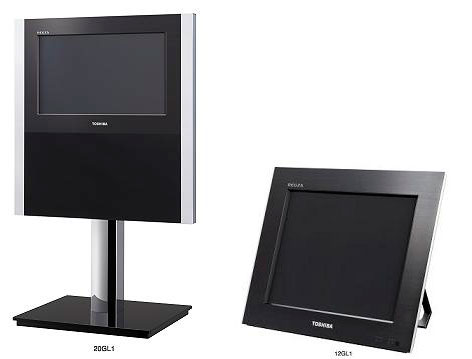 Founded on an idea Reiko Fukushima had nine years ago, coming back to work after maternity leave, Toshiba is now leading the charge on supplying the world’s first “naked-eye” 3-D TV. Recently covered in an interview with Fukushima in The New York Times, the progress of these developing technologies has done two things in Japan – sparked new heights for high-tech women researchers in that country and given confidence to all who were skeptical that a “naked-eye” technology could ever be developed.
Toshiba itself was skeptical when Fukushima first presented them the idea, but now last October at the Consumer Electronics Show in Las Vegas, the prototype of the 3-D TV was unveiled. It was always clear to Fukushima that 3-D glasses would have to go in order for the technology to truly take off, and her approach to the problem was to develop an algorithm that drew on a Toshiba imaging processor, named the “Cell,” to display nine different images for each frame. A sheet on the TV screen, called
Categories: Press , TV lift cabinet , Pop Up TV Cabinet , Toshiba , Glassless 3-D TVs , naked-eye 3-D , FukushimaPosted on: February 16, 2011Posted by: Kerry Mann