
Page 31 - Technology
-
Flat Panel TV Reviews Made Easy!
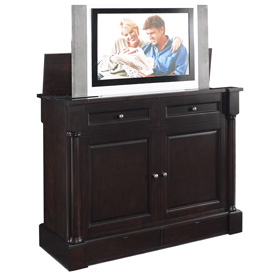
Are you in the market to replace your current flat panel TV? Do you have to purchase a TV for your TV lift cabinet? CNET offers a great resource for consumers looking to purchase flat panel TVs. Their posted reviews and feature articles are detailed and really break down the pros, cons, special features and what you’re getting for your money. For example, the article “Samsung, 2011 Plasma, LED TVs priced, shipping” has great comparisons with information on cost and when the particular model will be available for sale. There are full articles about Samsung and Panasonic’s new line up and seemingly endless reviews for any model you may be considering for your home. I really love the handy ‘Master Feature Chart’ available for reference on the Samsung page. Similar to our Printable Measurement Guide, it is a must-see before purchasing a TV for your TV lift cabinet. If you’re looking for a quick reference guide with easy browsing and detailed reviews – check out CNET’s review page!
Posted on: April 05, 2011Posted by: Kerry Mann -
Flat Panel TV Reviews Made Easy!
Are you in the market to replace your current flat panel TV? Do you have to purchase a TV for your TV lift cabinet? CNET offers a great resource for consumers looking to purchase flat panel TVs. Their posted reviews and feature articles are detailed and really break down the pros, cons, special features and what you’re getting for your money. For example, the article “Samsung, 2011 Plasma, LED TVs priced, shipping” has great comparisons with information on cost and when the particular model will be available for sale. There are full articles about Samsung and Panasonic’s new line up and seemingly endless reviews for any model you may be considering for your home. I really love the handy ‘Master Feature Chart’ available for reference on the Samsung page. Similar to our Printable Measurement Guide, it is a must-see before purchasing a TV for your TV lift cabinet. If you’re looking for a quick reference guide with easy browsing and detailed reviews – check out CNET’s review page!
Posted on: April 05, 2011Posted by: Kerry Mann -
It is Thursday Reveals Day - one day late
 Hi all,
It is time to reveal the answer to our weekly Friday Trivia Contest. Sorry for the delay. It has been crazy busy here.
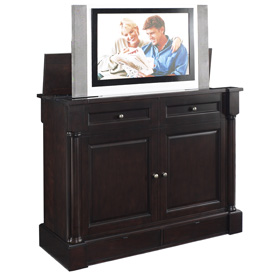
Question of the week: Out of the three TV lift cabinets listed below which one has the Infrared Relay system built in?
1.) Harbor
2.) Escape
3.) Wynterhall
The correct answer is Wynterhall.
Congratulations for all those who made it to our winners circle and received 10% OFF. If you did not guess correctly, you can always play again tomorrow.
Categories: TV Cabinets , discount , contest , trivia , Technology , Wynterhall TV Lift Cabinet , importadvantage promo codes , ImportAdvantage discountsPosted on: April 01, 2011Posted by: Kerry Mann -
It is Thursday Reveals Day - one day late
Hi all,It is time to reveal the answer to our weekly Friday Trivia Contest. Sorry for the delay. It has been crazy busy here.
Question of the week: Out of the three TV lift cabinets listed below which one has the Infrared Relay system built in?
1.) Harbor
2.) Escape
3.) Wynterhall
The correct answer is Wynterhall.
Congratulations for all those who made it to our winners circle and received 10% OFF. If you did not guess correctly, you can always play again tomorrow.
Categories: TV Cabinets , discount , contest , trivia , Technology , Wynterhall TV Lift Cabinet , importadvantage promo codes , ImportAdvantage discountsPosted on: April 01, 2011Posted by: Kerry Mann -
How Does 3D Work?
 You may have gone to the movie theater in the last two years to watch Avatar in 3-D, or perhaps you waited until it came out in Blu-ray to watch it at home in front of your TV lift cabinet. Regardless, you likely think that 3-D technologies are cool and will clearly be part of the entertainment industry’s future. But have you ever wondered how 3-D works? We uncovered some of the secrets of 3-D technology and we would like to share them.
Have you ever held up a pencil or finger and looked at it with one eye closed, then the other one closed? You’ll see that the image is the same, but it has a different perspective. This is “stereoscopy,” and it’s how the eyes and brain work together to create an impression of a third dimension. Our eyes are roughly 50 mm to 75 mm apart, and each eye takes in a different perspective, triggering the brain to do some crazy geometry to make up for the disparity between both images. It is this disparity that creates “3-D”.
So when we use technology to replicate
Posted on: February 18, 2011Posted by: Kerry Mann -
How Does 3D Work?
You may have gone to the movie theater in the last two years to watch Avatar in 3-D, or perhaps you waited until it came out in Blu-ray to watch it at home in front of your TV lift cabinet. Regardless, you likely think that 3-D technologies are cool and will clearly be part of the entertainment industry’s future. But have you ever wondered how 3-D works? We uncovered some of the secrets of 3-D technology and we would like to share them.Have you ever held up a pencil or finger and looked at it with one eye closed, then the other one closed? You’ll see that the image is the same, but it has a different perspective. This is “stereoscopy,” and it’s how the eyes and brain work together to create an impression of a third dimension. Our eyes are roughly 50 mm to 75 mm apart, and each eye takes in a different perspective, triggering the brain to do some crazy geometry to make up for the disparity between both images. It is this disparity that creates “3-D”.
So when we use technology to replicate
Posted on: February 18, 2011Posted by: Kerry Mann