
Made by Us, For Your Home | $200 Off Cabinets & $50 Off Lifts

Page 145 - Blog
-
Trendy TVs for Your Holiday Wishlist
Do you consider yourself a “trendy” TV-owner? Do you get a couple goose-bumps every time you raise your flat screen TV out of your TV lift cabinet? Are you also either planning to upgrade your TV or give one as a gift this holiday season? If you said “yes” to any of these questions, check out this list of the Top 5 Trendy TVS for 2010!
Before we launch right into the list, you should have a basic understanding of what makes a TV worth its weight in pixels. As you know, TVs range in price and quality, and if you don’t know what all those numbers and refresh rates mean on the sticker, you might get more than you need or, worse, not enough bang for your buck.
So let’s start with contrast ratios. Especially for larger TVs, resolution is highly important. The contrast ratio is the difference between the darkest and brightest colors the TV can display. It’s important that this number be very high. Good televisions offer at least a 6,000:1 contrast ratio.
Another important factor for buying a
Posted on: December 10, 2010Posted by: Kerry Mann -
Product Focus: Antiquity TV Lift Cabinet
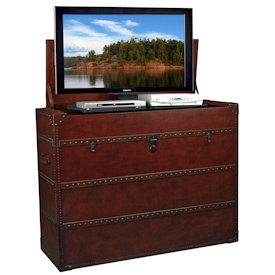
One of ImportAdvantage’s newest TV lift cabinet designs, the Antiquity TV Lift Cabinet is an ornately crafted cabinet built with a wood console covered in hand-cut distressed leather and finished with hundreds of individual hand-hammered antique nail heads. The result is an accurate throwback to antique steamer trunks used by the wealthy to travel around the globe.
The versatility of this finished-on-four-sides TV lift cabinet makes it perfectly suited for the foot of the bed, against a wall or standing alone in the middle of a room. The corners of this unique pop-up TV cabinet are precisely-stitched thick leather with horizontal oak slats complementing custom-made cast-metal antiqued hardware fittings.
The Antiquity TV Lift Cabinet can house most TVs between 32” and 47” and weighing up to 80 pounds. The electronics tray holds two media players directly under the TV. The pre-installed rank and pinion TV lift will raise and lower your TV and devices in near silence with the touch of a button.
Categories: Product FocusPosted on: December 09, 2010Posted by: Kerry Mann -
Product Focus: Antiquity TV Lift Cabinet
One of ImportAdvantage’s newest TV lift cabinet designs, the Antiquity TV Lift Cabinet is an ornately crafted cabinet built with a wood console covered in hand-cut distressed leather and finished with hundreds of individual hand-hammered antique nail heads. The result is an accurate throwback to antique steamer trunks used by the wealthy to travel around the globe.
The versatility of this finished-on-four-sides TV lift cabinet makes it perfectly suited for the foot of the bed, against a wall or standing alone in the middle of a room. The corners of this unique pop-up TV cabinet are precisely-stitched thick leather with horizontal oak slats complementing custom-made cast-metal antiqued hardware fittings.
The Antiquity TV Lift Cabinet can house most TVs between 32” and 47” and weighing up to 80 pounds. The electronics tray holds two media players directly under the TV. The pre-installed rank and pinion TV lift will raise and lower your TV and devices in near silence with the touch of a button.
Posted on: December 09, 2010Posted by: Kerry Mann -
Product Focus: Antiquity TV Lift Cabinet
One of ImportAdvantage’s newest TV lift cabinet designs, the Antiquity TV Lift Cabinet is an ornately crafted cabinet built with a wood console covered in hand-cut distressed leather and finished with hundreds of individual hand-hammered antique nail heads. The result is an accurate throwback to antique steamer trunks used by the wealthy to travel around the globe.
The versatility of this finished-on-four-sides TV lift cabinet makes it perfectly suited for the foot of the bed, against a wall or standing alone in the middle of a room. The corners of this unique pop-up TV cabinet are precisely-stitched thick leather with horizontal oak slats complementing custom-made cast-metal antiqued hardware fittings.
The Antiquity TV Lift Cabinet can house most TVs between 32” and 47” and weighing up to 80 pounds. The electronics tray holds two media players directly under the TV. The pre-installed rank and pinion TV lift will raise and lower your TV and devices in near silence with the touch of a button.
Posted on: December 09, 2010Posted by: Kerry Mann -
How Remote Controls Work
No one can deny the convenience of a television remote control these days. And now they seem to be able to do most anything – from changing channels to initiating recordings. But what is the technology behind these little devices that make them magically bring up the TV guide or raise and lower your flat screen television in your TV lift cabinet?
Remote controls were first used in WWI by German naval vessels to direct them into Allied boats. Then in WWII, remote controls were used for detonating bombs. Now over sixty years later, remote controls have a much more peaceful use.
For at-home use, most remote controls are powered by infrared (IR) technology. Infrared light is also referred to as “heat,” and remote controls rely on the use of light to carry its signal from the control to the device it directs. On the electromagnetic spectrum, infrared light falls on the invisible portion, between “visible” and “microwave.”
The signal sent out by the remote control is in binary code; that’s how
Categories: Infrared Relay SystemPosted on: December 08, 2010Posted by: Kerry Mann -
How Remote Controls Work
No one can deny the convenience of a television remote control these days. And now they seem to be able to do most anything – from changing channels to initiating recordings. But what is the technology behind these little devices that make them magically bring up the TV guide or raise and lower your flat screen television in your TV lift cabinet?
Remote controls were first used in WWI by German naval vessels to direct them into Allied boats. Then in WWII, remote controls were used for detonating bombs. Now over sixty years later, remote controls have a much more peaceful use.
For at-home use, most remote controls are powered by infrared (IR) technology. Infrared light is also referred to as “heat,” and remote controls rely on the use of light to carry its signal from the control to the device it directs. On the electromagnetic spectrum, infrared light falls on the invisible portion, between “visible” and “microwave.”
The signal sent out by the remote control is in binary code; that’s how
Categories: Infrared Relay System , TV lift cabinets , remote controls , binary codes , radio frequencyPosted on: December 08, 2010Posted by: Kerry Mann -
How Remote Controls Work
No one can deny the convenience of a television remote control these days. And now they seem to be able to do most anything – from changing channels to initiating recordings. But what is the technology behind these little devices that make them magically bring up the TV guide or raise and lower your flat screen television in your TV lift cabinet?
Remote controls were first used in WWI by German naval vessels to direct them into Allied boats. Then in WWII, remote controls were used for detonating bombs. Now over sixty years later, remote controls have a much more peaceful use.
For at-home use, most remote controls are powered by infrared (IR) technology. Infrared light is also referred to as “heat,” and remote controls rely on the use of light to carry its signal from the control to the device it directs. On the electromagnetic spectrum, infrared light falls on the invisible portion, between “visible” and “microwave.”
The signal sent out by the remote control is in binary code; that’s how
Categories: Infrared Relay System , TV lift cabinets , remote controls , binary codes , radio frequencyPosted on: December 08, 2010Posted by: Kerry Mann -
How Does Closed Captioning Work?
Whether the acoustics in your room are not top-notch, or you suffer from a hearing-impairment, closed captioning is a helpful tool that aids in the enjoyment of movies and television. But do you know how it works? Does it come through your television, antenna, satellite dish or cable box? If you have a TV lift cabinet, do you have to do any additional wiring or keep your media players in view to keep your closed captioning abilities? Here are the answers.
The ability for closed captioning is already embedded in the signal sent directly to your television, so every show, television movie and commercial comes with the possibility of closed captioning. In order for you to be able to read it, though, it has to be decoded, and that is done by your TV.
Since 1993, every television manufactured that measures over 13 inches must have a built-in decoder, per the Television Decoder Circuitry Act. The information for closed captioning is hidden in the “line 21 data” of your television signal, which
Categories: TVPosted on: December 07, 2010Posted by: Kerry Mann -
How Does Closed Captioning Work?
Whether the acoustics in your room are not top-notch, or you suffer from a hearing-impairment, closed captioning is a helpful tool that aids in the enjoyment of movies and television. But do you know how it works? Does it come through your television, antenna, satellite dish or cable box? If you have a TV lift cabinet, do you have to do any additional wiring or keep your media players in view to keep your closed captioning abilities? Here are the answers.
The ability for closed captioning is already embedded in the signal sent directly to your television, so every show, television movie and commercial comes with the possibility of closed captioning. In order for you to be able to read it, though, it has to be decoded, and that is done by your TV.
Since 1993, every television manufactured that measures over 13 inches must have a built-in decoder, per the Television Decoder Circuitry Act. The information for closed captioning is hidden in the “line 21 data” of your television signal, which
Posted on: December 07, 2010Posted by: Kerry Mann -
How Does Closed Captioning Work?
Whether the acoustics in your room are not top-notch, or you suffer from a hearing-impairment, closed captioning is a helpful tool that aids in the enjoyment of movies and television. But do you know how it works? Does it come through your television, antenna, satellite dish or cable box? If you have a TV lift cabinet, do you have to do any additional wiring or keep your media players in view to keep your closed captioning abilities? Here are the answers.
The ability for closed captioning is already embedded in the signal sent directly to your television, so every show, television movie and commercial comes with the possibility of closed captioning. In order for you to be able to read it, though, it has to be decoded, and that is done by your TV.
Since 1993, every television manufactured that measures over 13 inches must have a built-in decoder, per the Television Decoder Circuitry Act. The information for closed captioning is hidden in the “line 21 data” of your television signal, which
Posted on: December 07, 2010Posted by: Kerry Mann
