
Made by Us, For Your Home | $200 Off Cabinets & $50 Off Lifts

Page 146 - Blog
-
How Does Closed Captioning Work?
Whether the acoustics in your room are not top-notch, or you suffer from a hearing-impairment, closed captioning is a helpful tool that aids in the enjoyment of movies and television. But do you know how it works? Does it come through your television, antenna, satellite dish or cable box? If you have a TV lift cabinet, do you have to do any additional wiring or keep your media players in view to keep your closed captioning abilities? Here are the answers.
The ability for closed captioning is already embedded in the signal sent directly to your television, so every show, television movie and commercial comes with the possibility of closed captioning. In order for you to be able to read it, though, it has to be decoded, and that is done by your TV.
Since 1993, every television manufactured that measures over 13 inches must have a built-in decoder, per the Television Decoder Circuitry Act. The information for closed captioning is hidden in the “line 21 data” of your television signal, which
Posted on: December 07, 2010Posted by: Kerry Mann -
Amazon.com Seeking Movies and Screenplays for Amazon Studios
In mid-November, Amazon.com debuted Amazon Studios with the intent of soliciting screenplays from its users which (hopefully) will be produced into feature-length films with Warner Bros. Pictures. This means that novice and beginning screenwriters and filmmakers hoping to land that big contract may have a chance at making their dreams come true. It also means that winners can one day watch their hit movies on a TV screen that pops up from a TV lift cabinet from ImportAdvantage!
Already Amazon Studios has received more than a thousand scripts, and in honor of this milestone Amazon Studios announced a bonus contest, awarding $20,000 to each of the two best scripts uploaded by December 31, 2010. This bonus contest is in addition to the planned $1.1 million in awards Amazon Studios will give away in 2011, including $1 million for Best Movie and $100,000 for Best Script.
Submissions are being accepted in two formats: scripts and test movies. Full-length test movie entries must be at least 70
Categories: PressTags: Warner Bros. Pictures, TV lift cabinet, screenwriter, screenplay, movie, filmmaker, Amazon Studios, AmazonPosted on: December 06, 2010Posted by: Kerry Mann -
Amazon.com Seeking Movies and Screenplays for Amazon Studios
In mid-November, Amazon.com debuted Amazon Studios with the intent of soliciting screenplays from its users which (hopefully) will be produced into feature-length films with Warner Bros. Pictures. This means that novice and beginning screenwriters and filmmakers hoping to land that big contract may have a chance at making their dreams come true. It also means that winners can one day watch their hit movies on a TV screen that pops up from a TV lift cabinet from ImportAdvantage!
Already Amazon Studios has received more than a thousand scripts, and in honor of this milestone Amazon Studios announced a bonus contest, awarding $20,000 to each of the two best scripts uploaded by December 31, 2010. This bonus contest is in addition to the planned $1.1 million in awards Amazon Studios will give away in 2011, including $1 million for Best Movie and $100,000 for Best Script.
Submissions are being accepted in two formats: scripts and test movies. Full-length test movie entries must be at least 70
Categories: Press , TV lift cabinet , Amazon , Warner Bros. Pictures , screenwriter , screenplay , Amazon Studios , movie , filmmakerPosted on: December 06, 2010Posted by: Kerry Mann -
Amazon.com Seeking Movies and Screenplays for Amazon Studios
In mid-November, Amazon.com debuted Amazon Studios with the intent of soliciting screenplays from its users which (hopefully) will be produced into feature-length films with Warner Bros. Pictures. This means that novice and beginning screenwriters and filmmakers hoping to land that big contract may have a chance at making their dreams come true. It also means that winners can one day watch their hit movies on a TV screen that pops up from a TV lift cabinet from ImportAdvantage!
Already Amazon Studios has received more than a thousand scripts, and in honor of this milestone Amazon Studios announced a bonus contest, awarding $20,000 to each of the two best scripts uploaded by December 31, 2010. This bonus contest is in addition to the planned $1.1 million in awards Amazon Studios will give away in 2011, including $1 million for Best Movie and $100,000 for Best Script.
Submissions are being accepted in two formats: scripts and test movies. Full-length test movie entries must be at least 70
Categories: Press , TV lift cabinet , Amazon , Warner Bros. Pictures , screenwriter , screenplay , Amazon Studios , movie , filmmakerPosted on: December 06, 2010Posted by: Kerry Mann -
Most Soap Opera Ratings on the Rise, Except for One
Soap operas, also called “soaps” for short, are a continuous work of television drama aired in a serial format. The name for these on-going series came from their early days being broadcast as a weekday radio show, which was sponsored by soap manufacturers such as Procter & Gamble, Colgate-Palmolive and Lever Brothers, and played during a time when most of the listeners would be housewives.
By 1976, daytime television became “TV’s richest market,” at least according to Time magazine, primarily due to the soap operas’ dedicated fan base and growth of several series into a full hour slot, instead of a half-hour. The increase in length of the show allowed producers to essentially double the amount of advertising space available for each episode.
However, since the early 1990s daytime soap operas have been on a steady decline. In the 1991-92 TV season, an average of 6.5 million viewers watched “soaps,” but in the 2009-10 TV season, the number dropped to 1.3 million viewers. No new daytime
Categories: PressPosted on: December 03, 2010Posted by: Kerry Mann -
Most Soap Opera Ratings on the Rise, Except for One
Soap operas, also called “soaps” for short, are a continuous work of television drama aired in a serial format. The name for these on-going series came from their early days being broadcast as a weekday radio show, which was sponsored by soap manufacturers such as Procter & Gamble, Colgate-Palmolive and Lever Brothers, and played during a time when most of the listeners would be housewives.
By 1976, daytime television became “TV’s richest market,” at least according to Time magazine, primarily due to the soap operas’ dedicated fan base and growth of several series into a full hour slot, instead of a half-hour. The increase in length of the show allowed producers to essentially double the amount of advertising space available for each episode.
However, since the early 1990s daytime soap operas have been on a steady decline. In the 1991-92 TV season, an average of 6.5 million viewers watched “soaps,” but in the 2009-10 TV season, the number dropped to 1.3 million viewers. No new daytime
Categories: Press , television , Big Brother , ratings , Survivor , sweeps , All My Children , soap operasPosted on: December 03, 2010Posted by: Kerry Mann -
Most Soap Opera Ratings on the Rise, Except for One
Soap operas, also called “soaps” for short, are a continuous work of television drama aired in a serial format. The name for these on-going series came from their early days being broadcast as a weekday radio show, which was sponsored by soap manufacturers such as Procter & Gamble, Colgate-Palmolive and Lever Brothers, and played during a time when most of the listeners would be housewives.
By 1976, daytime television became “TV’s richest market,” at least according to Time magazine, primarily due to the soap operas’ dedicated fan base and growth of several series into a full hour slot, instead of a half-hour. The increase in length of the show allowed producers to essentially double the amount of advertising space available for each episode.
However, since the early 1990s daytime soap operas have been on a steady decline. In the 1991-92 TV season, an average of 6.5 million viewers watched “soaps,” but in the 2009-10 TV season, the number dropped to 1.3 million viewers. No new daytime
Categories: Press , television , Big Brother , ratings , Survivor , sweeps , All My Children , soap operasPosted on: December 03, 2010Posted by: Kerry Mann -
Product Focus: Crystal Pointe XL TV Lift Cabinet
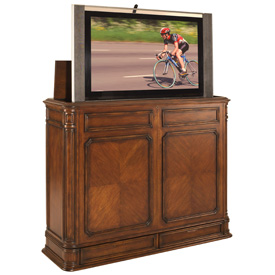
Hand-built from intricately carved African Mahogany veneer and rooted in classic design and corner pillars, the Crystal Pointe XL TV Lift Cabinet is a pop-up TV cabinet for all styles of home decor – from stately to modern. Inspired from antique European furniture, this TV lift cabinet is grandly scaled and intricately designed.
What really makes the Crystal Pointe XL TV Lift Cabinet unique and versatile is the fact that it is finished on all five exposed sides and its component drawers can be reversed so they open from the front or back. What this allows is that the TV lift cabinet can be positioned in the middle of a room as a divider, or against a wall or at the foot of a bed, while still being able access the TV screen and component drawers. Viewed from any angle, the Crystal Pointe XL TV Lift cabinet is an impressive display of handcrafted hardwood.
This TV lift cabinet is spacious enough to house a TV up to 51” wide and 33” tall, with component drawers measuring 22” wide. The pre-installed
Categories: Product FocusPosted on: December 02, 2010Posted by: Kerry Mann -
Product Focus: Crystal Pointe XL TV Lift Cabinet
Hand-built from intricately carved African Mahogany veneer and rooted in classic design and corner pillars, the Crystal Pointe XL TV Lift Cabinet is a pop-up TV cabinet for all styles of home decor – from stately to modern. Inspired from antique European furniture, this TV lift cabinet is grandly scaled and intricately designed.
What really makes the Crystal Pointe XL TV Lift Cabinet unique and versatile is the fact that it is finished on all five exposed sides and its component drawers can be reversed so they open from the front or back. What this allows is that the TV lift cabinet can be positioned in the middle of a room as a divider, or against a wall or at the foot of a bed, while still being able access the TV screen and component drawers. Viewed from any angle, the Crystal Pointe XL TV Lift cabinet is an impressive display of handcrafted hardwood.
This TV lift cabinet is spacious enough to house a TV up to 51” wide and 33” tall, with component drawers measuring 22” wide. The pre-installed
Posted on: December 02, 2010Posted by: Kerry Mann -
Product Focus: Crystal Pointe XL TV Lift Cabinet
Hand-built from intricately carved African Mahogany veneer and rooted in classic design and corner pillars, the Crystal Pointe XL TV Lift Cabinet is a pop-up TV cabinet for all styles of home decor – from stately to modern. Inspired from antique European furniture, this TV lift cabinet is grandly scaled and intricately designed.
What really makes the Crystal Pointe XL TV Lift Cabinet unique and versatile is the fact that it is finished on all five exposed sides and its component drawers can be reversed so they open from the front or back. What this allows is that the TV lift cabinet can be positioned in the middle of a room as a divider, or against a wall or at the foot of a bed, while still being able access the TV screen and component drawers. Viewed from any angle, the Crystal Pointe XL TV Lift cabinet is an impressive display of handcrafted hardwood.
This TV lift cabinet is spacious enough to house a TV up to 51” wide and 33” tall, with component drawers measuring 22” wide. The pre-installed
Posted on: December 02, 2010Posted by: Kerry Mann
