

If you've ever wished your living room could look like a living room — and not a home theater showroom — a TV lift cabinet might be exactly what you've been searching for. These ingenious pieces of furniture solve one of modern interior design's most persistent problems: the flat-screen TV dominates every wall and every glance, whether it's on or off.
The Basic Mechanism
At the heart of every TV lift cabinet is a motorized lift platform — typically a scissor-lift or column-lift design — that travels vertically inside a cabinet housing. The TV sits on a mounting platform attached to this lift. When activated, a low-voltage DC motor drives the lift upward through the cabinet top, raising the TV to eye level. When deactivated, the lift reverses and the TV descends back into the cabinet, where doors close (either automatically or manually, depending on the model) to conceal it entirely.
The lift mechanism itself is similar in concept to industrial lift technology, scaled and refined for residential use. Quality manufacturers engineer their lifts to handle hundreds of pounds and tens of thousands of cycles without failure.
What the Cabinet Looks Like
From the outside, a TV lift cabinet looks exactly like a fine piece of furniture — an armoire, a chest, a sideboard, a bed-foot bench, or a credenza, depending on the style you choose. The TV is completely invisible until you activate the lift. Cabinet materials range from solid hardwoods and veneers to painted MDF and lacquered finishes, spanning styles from traditional to ultra-modern.
How You Control It
Most TV lift cabinets include a handheld remote control as standard. Many higher-end models also accept integration with home automation platforms like Control4, Savant, Lutron, or Amazon Alexa — meaning you can raise your TV with a voice command or include it in a "Movie Night" scene that dims the lights and closes the blinds at the same time.
Where They're Used
TV lift cabinets are popular in bedrooms, living rooms, dining rooms, home offices, and outdoor entertaining spaces. They're especially prized in rooms where aesthetics matter — formal living rooms, master suites, boutique hotels, and vacation homes where the owner doesn't want the TV to define the space's character.
Are There Different Types?
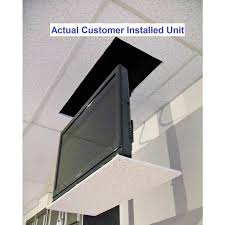
Yes. The most common is the upward-rising lift housed in a floor-standing cabinet. There are also ceiling drop-down lifts, which conceal the TV in a ceiling cavity and lower it into view — popular in bedrooms where the TV faces the bed. Under-bed lifts slide the TV out from the foot of the bed platform. And swivel lifts raise and rotate the TV to face different seating positions.
Each type has its ideal use case, and a knowledgeable TV lift retailer can help you match the right mechanism to your room and viewing habits.
Ready to see TV lift cabinets in every style and size? Browse the full collection at TVLiftCabinet.com — from traditional armoires to modern pop-up consoles.