
lift mechanism

  1. Linear Actuator vs. Scissor Lift: Which TV Lift Mechanism Is Better?

    Linear actuators and scissor lifts are the two main TV lift mechanisms on the market. A full comparison of speed, noise, weight capacity, cost, and long-term durability.

    Every TV lift cabinet is built around one of two core mechanism types, and the difference between them shapes everything from noise level to how heavy a TV you can safely lift. Here's a full side-by-side breakdown.

    How each mechanism works

    Linear actuator: A motor drives a threaded rod or screw mechanism that extends and retracts in a straight vertical line, pushing the TV mounting bracket directly upward. The motion is a single, direct line of force.

    Scissor lift: A folding metal lattice — imagine an accordion made of metal struts expands vertically as the motor drives the base of the lattice together, and collapses down as it's driven apart. The TV mount sits atop the lattice and rises as it unfolds.

    Speed and consistency of motion

    Linear actuators tend to maintain a more consistent speed through the entire range of travel,

    Posted on: July 19, 2026
    Posted by: Jenn Mann
  2. How Does a TV Lift Mechanism Actually Work?

    A plain-language breakdown of how TV lift mechanisms work the motor, the mount, and the safety features that keep your TV moving smoothly.

    At its core, a TV lift mechanism is a motorized system that raises a mounted TV vertically out of a cabinet, and lowers it back down, on command.

    The main components:

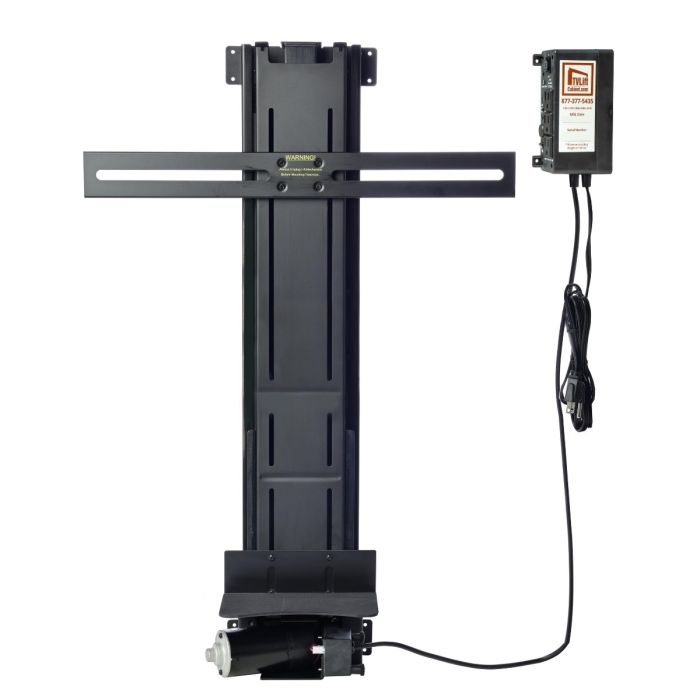
    • Linear actuator or scissor-lift motor — the drive system that generates vertical movement. Linear actuators use a motor-driven screw or rod; scissor mechanisms use a folding metal lattice that extends and collapses.
    • Mounting bracket — attaches the TV (standard VESA pattern) to the top of the lift carriage
    • Guide rails — keep the TV moving in a straight, stable vertical path without wobble
    • Control system — a remote, wall switch, or app that sends the raise/lower signal
    • Safety sensors — most quality mechanisms include obstruction detection, which stops or reverses the lift if it meets resistance (a hand, a pet, a stray cable)

    How it moves: When you trigger the lift, the motor drives the actuator

    Posted on: July 15, 2026
    Posted by: Jenn Mann
  3. What Is a TV Lift Cabinet and How Does It Work?

    If you've ever wished your living room could look like a living room — and not a home theater showroom — a TV lift cabinet might be exactly what you've been searching for. These ingenious pieces of furniture solve one of modern interior design's most persistent problems: the flat-screen TV dominates every wall and every glance, whether it's on or off.

    The Basic Mechanism

    At the heart of every TV lift cabinet is a motorized lift platform — typically a scissor-lift or column-lift design — that travels vertically inside a cabinet housing. The TV sits on a mounting platform attached to this lift. When activated, a low-voltage DC motor drives the lift upward through the cabinet top, raising the TV to eye level. When deactivated, the lift reverses and the TV descends back into the cabinet, where doors close (either automatically or manually, depending on the model) to conceal it entirely.

    The lift mechanism itself is similar in concept to industrial lift technology, scaled and refined for residential

    Posted on: June 13, 2026
    Posted by: Jenn Mann
  4. TV Lift Cabinet Installation Tips (Without Hiring Professionals)

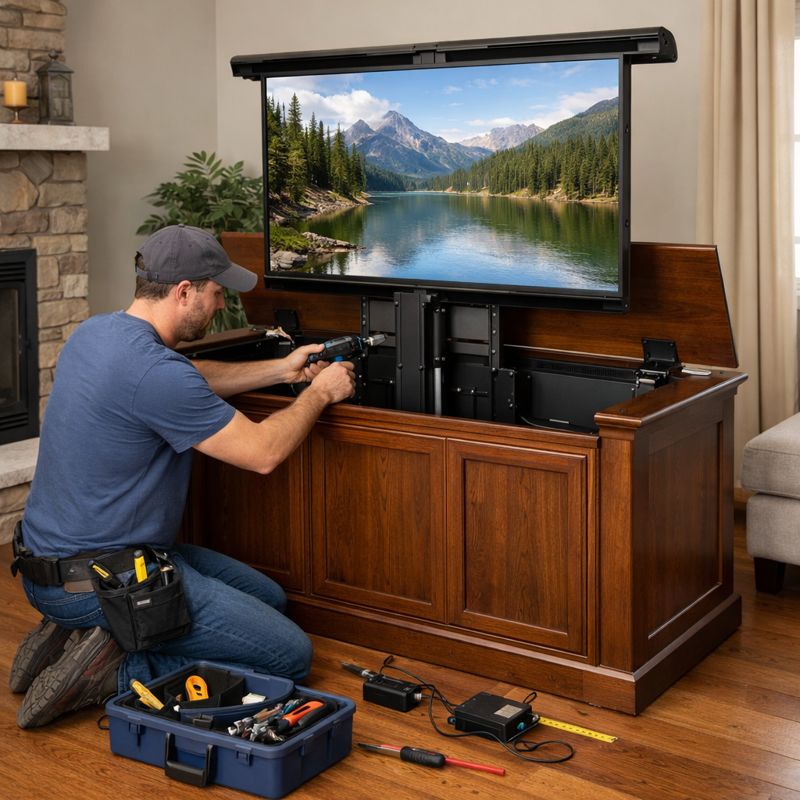
    Installing a TV lift cabinet may seem daunting, but many models from TVLiftCabinet.com are designed for straightforward assembly with minimal tools. Planning and preparation are key to a smooth installation that ensures your cabinet performs flawlessly.

    Featured Product: Clubside TV Lift Cabinet
    Clubside TV Lift Cabinet – Fits most 55″ TVs, features soft-close doors, and a reliable lift mechanism that can be controlled via RF remote. Perfect for living rooms or compact spaces.

    Start by measuring your room carefully, including floor space, wall clearance, and ceiling height. Make sure the cabinet has sufficient space for the lift to fully extend. Place the cabinet on a level surface to prevent wobbling and ensure the TV rises smoothly.

    Next, route all cables properly before mounting the TV. Use cable management channels or tie-downs to avoid pinching wires during lift operation. A clean cable setup ensures safety and preserves the cabinet’s aesthetic.

    Once your TV is mounted, test the lift

    Posted on: February 16, 2026
    Posted by: Jenn Mann
  5. Turn Your Cabinet into a State-of-the-Art TV Lift

    My husband would love to have everything in our home attached to his remote control. Getting up

    TV Lift Cabinet Nick Ferry's Finished Cabinet

    and messing with the television controls just isn’t necessary in a world with automatic cars. Right?

    Well, the jury is still out on the auto cars, but if there’s a way to make television viewing easier, I’m all for it (because it makes MY life easier, too). So, if you have a flat screen television and a beautiful entertainment cabinet, you can easily add an electronic lift function to your cabinet with a TV Lift mechanism from TVLiftCabinet.

    The company provides uplift motorized TV lift series for furniture companies and individuals who want to convert their cabinets into TVLiftCabinets. The mechanisms are easy to set up. You television snaps into the lift mechanism with two bolts. Check out how woodworker Nick Ferry built his own TV Lift Cabinet using one of these lifts!

    Safety is key to the lift mechanisms. Built-in pressure sensors immediately stops movement

    Posted on: October 19, 2016
    Posted by: Kerry Mann
  6. Build Your Own Cabinet Using our TV Lift Mechanism with 12-Volt Trigger

    Are you a “Do-it-Yourself” person?  Then perhaps building your own TV Lift Cabinet and installing our lift mechanism is the best solution for you.

    One of our customers, who purchased our Uplift 3700 Lift mechanism, recently shared his project results with us.   He was able to convert a birch dresser cabinet into his own TV Lift Cabinet.  He removed the dresser drawers and installed a center compartment for his speakers.  In the back of the cabinet he installed our Uplift lift Mechanism directly behind the speaker compartment.  The end result is one impressive home-made TV Lift Cabinet!


    This customer did, however, have a question regarding our 12-Volt Trigger feature.

    Customer Question:

    How does one use the 12-volt power outlet located on the lift mechanism?  I am trying to devise a way to get IR commands into the cabinet to activate a receiver, the lift mechanism and a 42-inch plasma TV.

    Our Answer:

    To use the 12 volt trigger you will need a 1/8” stereo jack.

    Posted on: December 09, 2011
    Posted by: Kerry Mann
  7. Build Your Own Cabinet Using our TV Lift Mechanism with 12-Volt Trigger

    Are you a “Do-it-Yourself” person?  Then perhaps building your own TV Lift Cabinet and installing our lift mechanism is the best solution for you.

    One of our customers, who purchased our Uplift 3700 Lift mechanism, recently shared his project results with us.   He was able to convert a birch dresser cabinet into his own TV Lift Cabinet.  He removed the dresser drawers and installed a center compartment for his speakers.  In the back of the cabinet he installed our Uplift lift Mechanism directly behind the speaker compartment.  The end result is one impressive home-made TV Lift Cabinet!


    This customer did, however, have a question regarding our 12-Volt Trigger feature.

    Customer Question:

    How does one use the 12-volt power outlet located on the lift mechanism?  I am trying to devise a way to get IR commands into the cabinet to activate a receiver, the lift mechanism and a 42-inch plasma TV.

    Our Answer:

    To use the 12 volt trigger you will need a 1/8” stereo jack.

    Posted on: December 09, 2011
    Posted by: Kerry Mann